perspective and composition are useful techniques when create art and modelling for games, the techniques that are used in certain images are there to create a unique composition and draw the viewer to parts of the image.
1 Point Perspective:
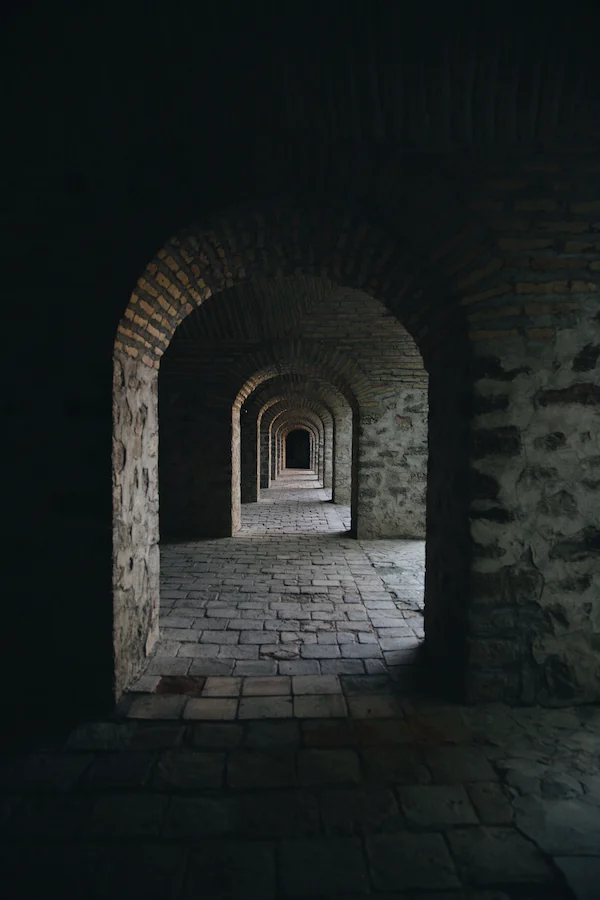
1 Point perspective has only a single vanishing point, most images make use of strong lines that disappear along a horizontal line. All of the faces that they viewer can see remain the same shape they should be and are not distorted in anyway by the vanishing point.
2 Point Perspective:

2-point perspective makes use of 2 vanishing points, they are along a single line that is either vertical or horizontal across an image or concept. this technique can must commonly be seen in concepts or images where it the image is viewing a corner of a building, like in the image above.
3 Point Perspective:
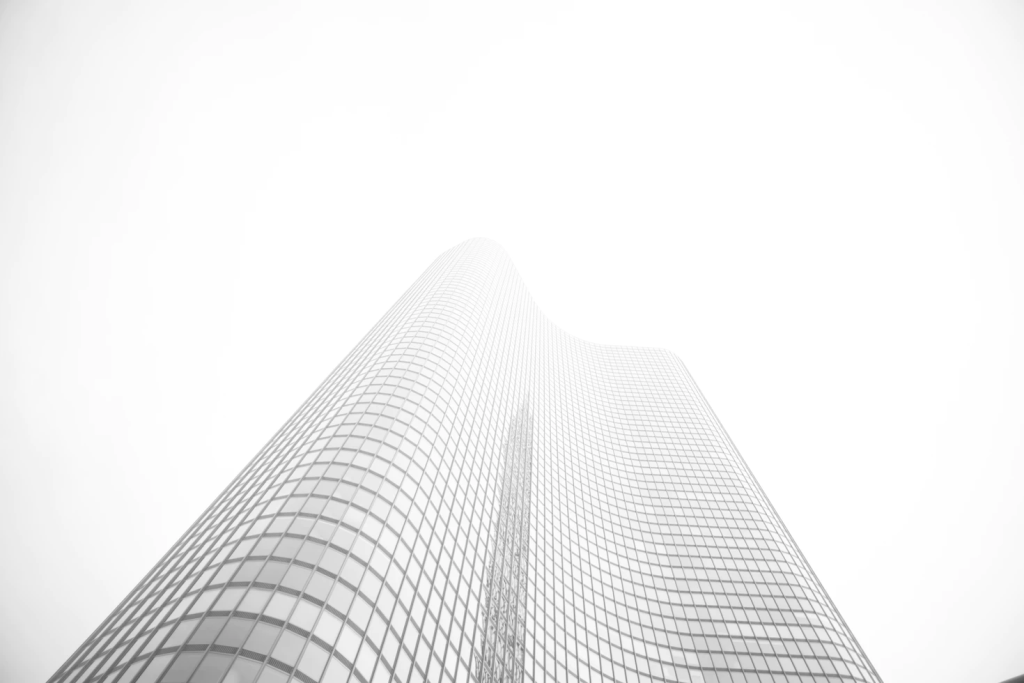
Makes use of 3 vanishing points, this 3rd vanishing point is often not seen in the image and is below the horizon, so they are similar to 2-point perspective works. this is used to create realistic depth in drawings and concepts as the 3rd vanishing point is often far off the canvas or viewable image.
In the case of the image above there are 2 vanishing points at either end of the building and one where it meets the sky as the suns light block most of the view of the top. An image of a building making use of bird’s eye view composition would make for a better example.
4, 5 and 6 Point Perspective:
4, 5 and 6 point perspective is used when creating character concept art or to create more distorted, dynamic and dramatic images that make use of several vanishing points.
Composition Techniques.
image composition techniques are methods that an artist can use to make an image more appealing to the viewer.
- rule of thirds – divides an image in to a 3 by 3 grid, where the middle lines meet is where you want the focal point of the image to be
- golden ratio – this applies to the use of curves and
- focal point – an area within the image that the artist draws attention to, they may use other composition techniques to direct the viewer to the point.
- contrast – use of colour and value to make part of the image more interesting and stand out
- blank space – the use of blank white space to draw the viewer to a certain point in the image
- repetition – use of repeated shapes, mainly used in manmade structures as nothing in nature is ever the same
- rhythm and flow – this is where lines are used to direct the viewer to a certain point in an image, they could be lines of buildings or a path to the strokes of the pencil
- colour – colours that compliment and work well together to make an interesting image
- size variation – use of varying sizes of shapes and objects within the image to create a unique composition
- asymmetry and symmetry – symmetrical objects within an image where they look the exact same on either side. Asymmetry is where the image is symmetrical but there is something slightly different that makes it stand out.
- layers – where parts of the image are layered to create the foreground and background
- tangents – used when placing objects within concepts.
My Own Work:
To start I had a play around in photoshop with drawing boxes, I set up a 3×3 grid that I used to place the vanishing point and started drawing different boxes at different angles that I then turned into books with some colour and illustration.
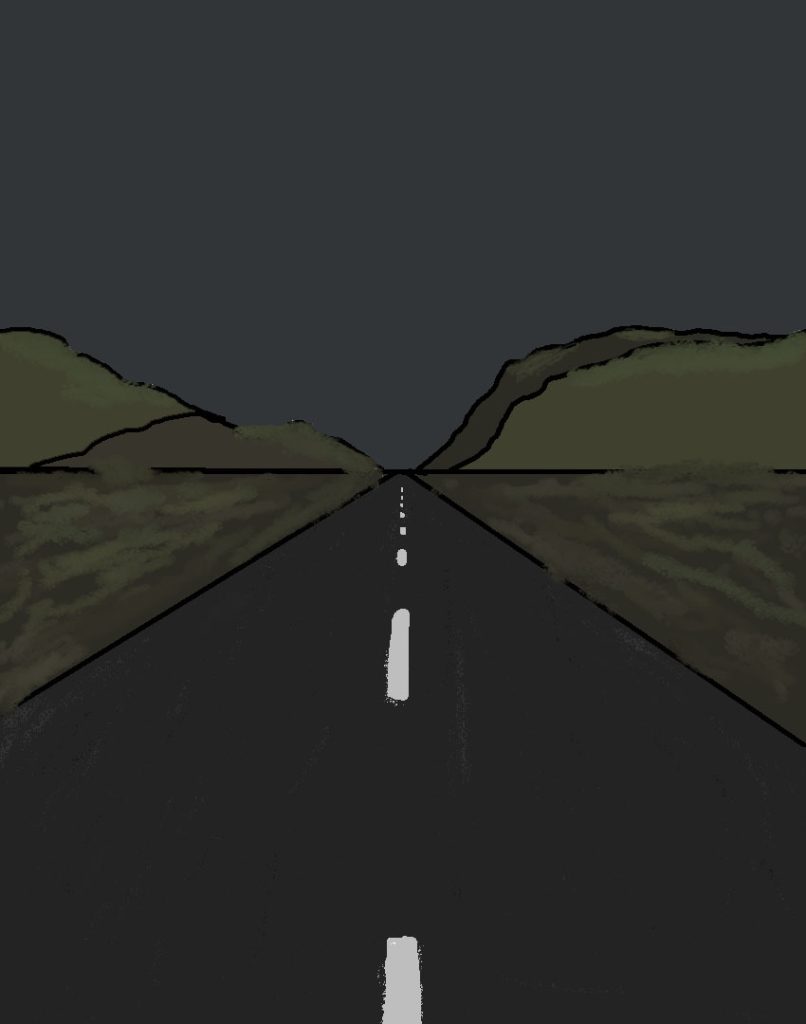
I then used that knowledge and technique to create a 1-point perspective landscape, I chose to have a long road that directed the view to the vanishing point in the distance. I chose to use this idea because I thought I could replicate a similar image I took in the Lake District for some college photography work.
Reflection:
I have Experimented with Perspective and it is a technique I was familiar with before having done Photography. For my Piece I decided to look at a photo I had Taken whilst on Holiday in the Lake District and Take inspiration from that image.
I know that I would like to try my and create some more work on Perspective and possibly look a 2- or 3-point perspective and look at creating art with that in mind.
I think I could definitely improve on my work, it seems very basic and bland in terms of colour and vibrancy to what I have previously created I would Like to look at creating a realistic sky and creating depth and a weathered look to the road.
References:
Unsplash Shapelined (2017) Brick hallway perspective image [Photograph] . Available Online; brick walled hallways photo – Free Perspective Image on Unsplash [Accessed 6/11/2022]
Unsplash Francistogram (2018) Road surrounded by trees [Photograph] . Available Online; asphalt road photo – Free Nature Image on Unsplash [Accessed 18/10/2022]
Whelan, S. (2017) Tall Glass Building [Photograph] . Available Online; glass building under gray sky during daytime photo – Free Grey Image on Unsplash [Accessed 4/11/2022]
Venkatesh, S. (n.d.) The Louvre, Paris, France. 2-point perspective photo [Photograph] . Available Online; Blog #4: 2 Point Perspective (IDEA) – Sahana Venkatesh Photography Website (wordpress.com) [Accessed 7/12/2022]